
Your business needs digital marketing skills, and you need them fast. Before you enrol your team in any programme, check one thing first: the syllabus. A strong digital marketing course syllabus tells you exactly what your employees will learn, how long the training takes, and whether it matches your company’s real goals. A weak digital marketing course syllabus wastes your training budget and your team’s time.
This guide breaks down what a complete digital marketing course syllabus 2026 should include, how a basic programme compares to an advanced digital marketing course syllabus, and why PIMS (Professional Institute of Marketing & Strategy) builds its programmes around real business outcomes, not just theory. Whether you run a startup, manage a marketing team, or lead HR and L&D decisions at a growing company, this blog gives you a clear way to judge any digital marketing course syllabus before you invest in it.
What a Digital Marketing Syllabus Actually Covers in 2026
A digital marketing course syllabus is the roadmap of everything a learner studies during a training programme. It lists the modules, the tools, the skills, and the real projects covered from day one to the final class. Think of it as a blueprint. Before you build anything, you check the blueprint. Before your team joins a course, you check the digital marketing syllabus.
For businesses, this matters even more. You are not just training one person. You are investing in a skill set that should show up in your website traffic, your ad performance, and your sales numbers. A clear digital marketing syllabus helps you decide if a programme will actually move those numbers or if it will just hand your team a certificate with no real skill behind it.
Why the Digital Marketing Syllabus 2026 Looks Different
Marketing changed fast over the last two years. Search engines now show AI-generated answers at the top of results. Buyers research on five platforms before they ever visit your website. Because of this, the digital marketing course syllabus 2026 covers more than SEO and social media basics.
A modern digital marketing course syllabus in 2026 includes AI tools, automation, and data-led decision-making right alongside SEO, paid ads, and content marketing. If a course still teaches digital marketing the way it did years ago, your team walks out with outdated skills. That is a real risk for any business that depends on digital growth.
PIMS updates its digital marketing course syllabus every year to match these shifts. This is not a marketing line. It is a practical need, because platforms like Google, Meta, and LinkedIn change their algorithms and ad tools constantly. A syllabus that does not keep up leaves your team behind your competitors.
10 Essential Pillars of Digital Marketing Syllabus in 2026
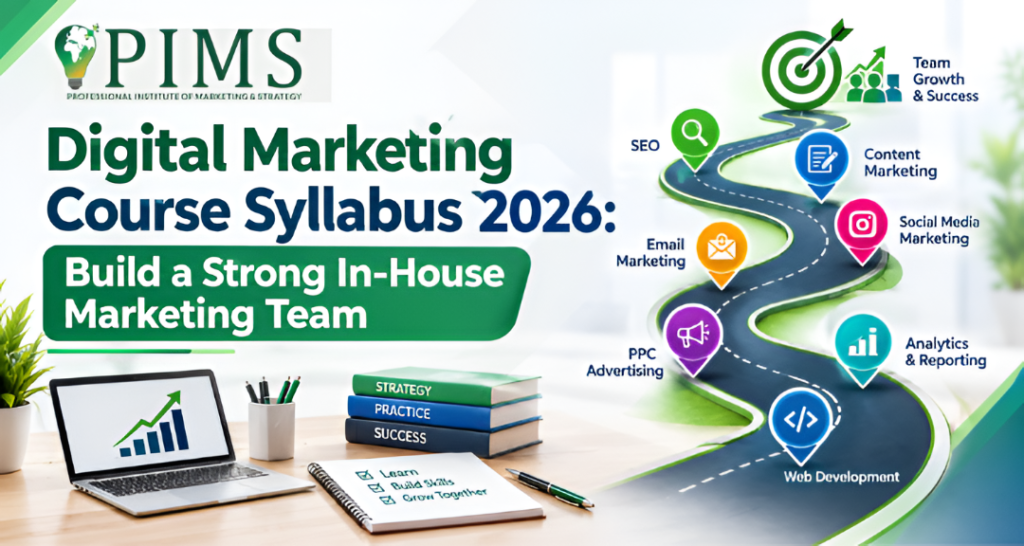
Every strong digital marketing course syllabus, whether it is a short certificate or a full diploma, should walk through the same core pillars. Here is what to look for.
- Digital Marketing Foundations: This module covers the marketing funnel, consumer behavior, brand positioning, and how online and offline marketing connect. Your team should leave this section understanding how a customer moves from awareness to purchase.
- Website and Landing Page Basics: A digital marketing course syllabus should teach how websites and landing pages work, because every campaign eventually sends traffic somewhere. This includes website structure, conversion-focused design, and simple tools like WordPress.
- Search Engine Optimization (SEO): SEO remains one of the highest-return skills in any digital marketing course syllabus. This covers keyword research, on-page SEO, technical SEO, local SEO, and off-page link building. Businesses that rank well on Google save money on paid ads over time.
- Search Engine Marketing (SEM) and Google Ads: This module trains learners to run Google Search, Display, Shopping, and Video ad campaigns. A good digital marketing course syllabus 2026 also covers Performance Max campaigns and AI-based bidding, since Google now pushes most advertisers toward automated tools.
- Social Media Marketing: This covers organic content strategy and paid social ads across Instagram, Facebook, LinkedIn, and YouTube. For B2B companies, LinkedIn strategy deserves extra attention, since most business buyers research vendors there first.
- Content Marketing and Copywriting: Content drives every other channel. This module teaches blog writing, ad copy, email copy, and video scripting, along with frameworks like AIDA and PAS that turn plain writing into persuasive writing.
- Email Marketing and Automation: Email still delivers strong returns for businesses. This module covers list building, segmentation, automated email flows, and campaign analytics.
- Web Analytics and Reporting: Every advance digital marketing course syllabus includes Google Analytics 4, Google Search Console, and Google Tag Manager. Your team should walk away knowing how to read a report and turn it into a decision, not just a chart.
- AI Tools and Automation: This is the newest and most important addition to any digital marketing syllabus 2026. Learners study how to use AI tools for research, content drafting, ad copy generation, and campaign automation, while still applying human judgment and brand voice on top.
- Live Projects and Capstone Work: A digital marketing course syllabus without live projects is incomplete. Real campaigns, real budgets, and real client-style problems are what turn theory into a skill your business can actually use.
Digital Marketing Syllabus 2026: Syllabus at a Glance
| Module | What It Covers | Business Value |
|---|---|---|
| Foundations & Strategy | Funnels, consumer behavior, brand positioning | Aligns marketing with business goals |
| SEO | On-page, technical, local, off-page | Long-term, low-cost traffic growth |
| SEM & Google Ads | Search, Display, Shopping, Performance Max | Fast, measurable lead generation |
| Social Media Marketing | Organic and paid, LinkedIn for B2B | Brand visibility and community trust |
| Content Marketing | Blogs, copywriting, video scripts | Supports every other channel |
| Email Marketing | Automation, segmentation, analytics | High ROI customer retention |
| Web Analytics | GA4, Search Console, GTM | Data-backed decisions |
| AI Tools & Automation | Prompting, AI-assisted campaigns | Faster execution, lower cost per task |
| Live Projects | Real campaigns and reporting | Job-ready and business-ready skills |
Basic vs. Advanced Digital Marketing Course Syllabus: What’s the Real Difference?
Not every digital marketing course syllabus is built the same way. Understanding the difference between a basic programme and an advanced digital marketing course syllabus helps you pick the right option for your team.
A basic digital marketing syllabus usually covers the fundamentals: SEO basics, social media posting, simple Google Ads setup, and an introduction to analytics. This works well for someone who needs a general understanding of digital channels, such as a founder who wants to manage marketing on the side.
An advanced digital marketing course syllabus goes much further. It adds technical SEO audits, multi-channel paid ad strategy, marketing automation, AI-powered campaign tools, and full analytics reporting. This level fits business owners, marketing managers, and team leads who need to run or oversee real campaigns with real budgets.
At PIMS, both paths exist under one roof. Businesses can pick the depth that fits their team’s role, from a foundational digital marketing syllabus for new hires to an advanced digital marketing course syllabus for managers who need to own strategy and reporting.
Why AI Is Now a Core Part of Every Digital Marketing Syllabus 2026
You cannot separate AI from marketing anymore. Every current digital marketing course syllabus 2026 needs a dedicated section on how AI tools fit into daily marketing work. This includes using AI for keyword research, ad copy generation, content outlines, and campaign optimization.
Search engines have also changed how they show results. Google’s AI Overviews now answer many queries directly, without a click. This means your business needs a team that understands generative engine optimisation, known as GEO, not just traditional SEO. A future-ready digital marketing syllabus prepares your team to get cited inside AI answers, not just ranked on a results page.
PIMS builds AI training directly into its digital marketing course syllabus, so your team learns to use these tools responsibly, without losing brand voice or accuracy.
Digital Marketing Course Syllabus in 2026: Duration and Format Options
Businesses often ask how long a digital marketing course syllabus in 2026 takes to complete. The honest answer: it depends on depth.
| Program Type | Typical Duration | Best For |
|---|---|---|
| Short certificate course | 4-8 weeks | Quick skill boost, single-channel focus |
| Comprehensive certification | 3-6 months | Job-ready, full-channel training |
| Advanced or executive programme | 6-12 months | Managers and strategic decision-makers |
| Corporate training track | Custom schedule | Teams upskilling together |
PIMS offers flexible batch timings and a dedicated Corporate Digital Marketing Training track, so your business does not have to pull the whole team off the floor at once. You can review current batch schedules and course fees directly with the PIMS team before you commit.
Career and Business Outcomes After Completing the Syllabus
A well-built digital marketing course syllabus should lead to real outcomes. For individuals, that means roles like SEO Executive, Social Media Manager, Performance Marketing Specialist, Content Marketing Manager, or Digital Marketing Manager. For businesses, that means an in-house team that can run campaigns without depending fully on outside agencies.
This is where a digital marketing course syllabus 2026 pays for itself. When your team can plan, execute, and report on campaigns internally, you cut agency costs, react faster to market changes, and keep your marketing knowledge inside your own company instead of outsourcing it every time.
Think about the last time your business waited on an outside agency for a simple campaign change. A trained in-house team removes that delay. Your people know your product, your customers, and your brand voice better than any outside vendor ever will. Once they also know the tools and channels, they can move at the speed your business actually needs.
There is a cost side to this too. Agency retainers add up month after month, whether or not campaigns perform. Training your own team is a one-time investment that keeps paying off long after the course ends. Every campaign your team runs afterward builds on skills they already own.
Why Businesses Choose PIMS for Digital Marketing Training
PIMS (Professional Institute of Marketing & Strategy) has spent years building a digital marketing course syllabus that businesses in Noida, Delhi NCR, and beyond actually trust. Here is what sets PIMS apart for B2B training needs.
- Practical, Not Just Theoretical: PIMS builds every module around live projects and real campaigns, not just slides and definitions. Your team practices on real tools, not screenshots.
- Full-Spectrum Courses: PIMS offers a complete Digital Marketing Course, along with focused programs like the SEO Course, Google Ads Course, and SMM and SMO Training. This lets your business pick a full curriculum or a targeted skill upgrade, depending on what your team needs.
- Corporate Training Support: PIMS runs a dedicated Corporate Digital Marketing Training program, built for businesses that want to train multiple employees together in one shared program.
- Expert-Led Instruction: Working professionals teach every module at PIMS, so your team learns from people who run real campaigns, not just people who read about them.
- Location and Access: PIMS operates from Sector 16, Noida, with flexible timings from Monday to Saturday, making it a practical choice for businesses across Delhi NCR that want in-person or hybrid training options.
- Free Orientation Classes: Before your business commits, PIMS offers a free orientation session so your team can experience the teaching style and course structure firsthand.
If your business wants a partner that treats a digital marketing course syllabus as a business investment, not just a classroom checklist, PIMS is built for that role.
How to Evaluate Any Digital Marketing Course Syllabus in 2026 Before You Enroll
Use this quick checklist before your business signs off on any training program:
- Does the program include AI tools and GEO, not just traditional SEO?
- Does it offer both a basic path and a deeper, more advanced path?
- Are there live projects, or only recorded lessons?
- Does the institute offer corporate or team-based batches?
- Can you speak with instructors or see sample work before enrolling?
- Does the digital marketing course syllabus 2026 map to real job roles and business functions your team needs?
If a program checks every box, you are looking at a digital marketing course syllabus 2026 worth your training budget.
Conclusion
A strong digital marketing syllabus 2026 is not just a list of topics. It is a business decision. It decides how fast your team learns, how well they perform, and how much value your training budget actually delivers. As you compare programmes, keep coming back to the same question: does this digital marketing course syllabus in 2026 match where your business is headed, or where marketing used to be?
PIMS builds its training around real business needs, real tools, and real outcomes, backed by a Corporate Digital Marketing Training track built for teams like yours. If your business is ready to close the digital skills gap, reach out to PIMS today and ask about the 2026 digital marketing syllabus, batch timings, and corporate training options. Your team’s next campaign could be the one that finally runs in-house.
Frequently Asked Questions
Explore clear answers to common questions about the digital marketing course syllabus in 2026, including modules, duration, practical training, AI tools, and career outcomes.
1. What does a digital marketing course syllabus in 2026 usually include?
A complete program covers SEO, SEM, social media marketing, content marketing, email marketing, web analytics, and AI tools, along with live projects. The exact depth depends on whether it is a basic or a deeper, advanced path.
2. How is the digital marketing course syllabus 2026 different from older syllabi?
It adds AI-driven tools, automation, and Generative Engine Optimization, which older programs did not cover at all.
3. Is there a difference between a basic and a more advanced program?
Yes. A basic program covers fundamentals for beginners, while a more advanced option adds technical SEO, AI-powered campaign management, and full-scale analytics reporting for managers and strategists.
4. Can PIMS train an entire team, not just individuals?
Yes. PIMS runs a dedicated Corporate Digital Marketing Training program built specifically for businesses that want to train several employees together.
5. How long does the digital marketing course syllabus in 2026 take to complete at PIMS?
Duration depends on the course level, ranging from short certificate programs of a few weeks to comprehensive tracks that run several months. PIMS can guide your business toward the right format based on your team’s schedule.
6. Does the PIMS program include practical projects?
Yes. PIMS builds its training around live projects and real campaign work, so learners graduate with practical experience, not just theory.
7. Who should choose a more advanced learning path?
Business owners, marketing managers, and team leads who need to own strategy, run multi-channel campaigns, and report on results should choose the deeper, more advanced option.
